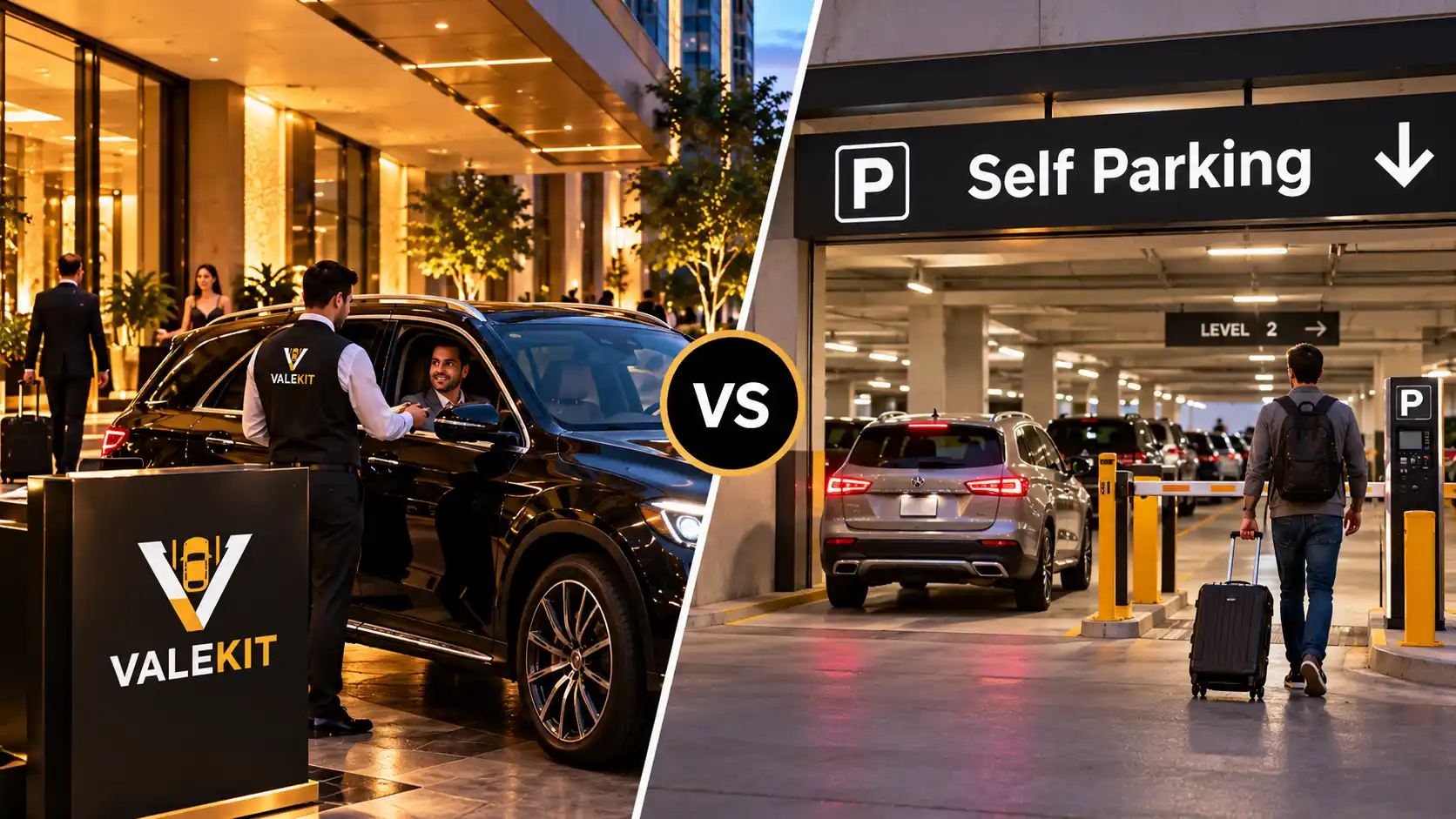
Choosing between valet and self-parking affects your hotel's operating costs, guest experience, and parking management. Each model has its own benefits and challenges. This guide compares valet and self-parking to help you decide which option best fits your hotel's needs.
Key Differences Between Valet and Self-Parking
The choice between self-park lots and valet teams changes your daily work, driveway flow, and guest smiles.
| Factor | Self-Parking | Valet Parking |
|---|---|---|
| Parking process | Guests find an available spot and park their own vehicles | Guests hand over their vehicles to valet staff at the entrance |
| Key handling | Guests keep their car keys | Valet staff collect and manage the keys |
| Luggage assistance | Guests carry their luggage to the hotel lobby | Staff can help unload luggage at the entrance |
| Vehicle parking | Guests park in an available space themselves | Trained staff parks the vehicle in a designated lot |
| Vehicle retrieval | Guests return to the parking area and collect their cars | Guests request their cars from valet staff when ready to leave |
| Payment | Guests pay at a parking machine, pay box, or through their room bill | Hotels collect payment at the valet stand or add it to the guest's room bill |
Lot Space and Vehicle Capacity
The parking model affects how many vehicles your hotel can accommodate. Here is how self-parking and valet use available space differently.
| Factor | Self-Parking | Valet Parking |
|---|---|---|
| Space requirements | Needs wider parking spaces and driving lanes for guests to move. | Staff can park vehicles closer together in designated areas. |
| Driving lanes | Requires enough room for guests to turn and park safely. | Needs less space for individual vehicle movement. |
| Parking capacity | Usually accommodates fewer vehicles in the same area due to wider gaps and driving lanes. | Can accommodate more vehicles through organized parking arrangements. |
| Space management | Guests find and use available spaces themselves. | Staff manage vehicle placement and retrieval using hotel valet software. |
Labor Costs and Daily Revenue
How you run your lot changes how much cash you spend on staff and make each day. Both setups bring in money, but they balance costs and profits in different ways.
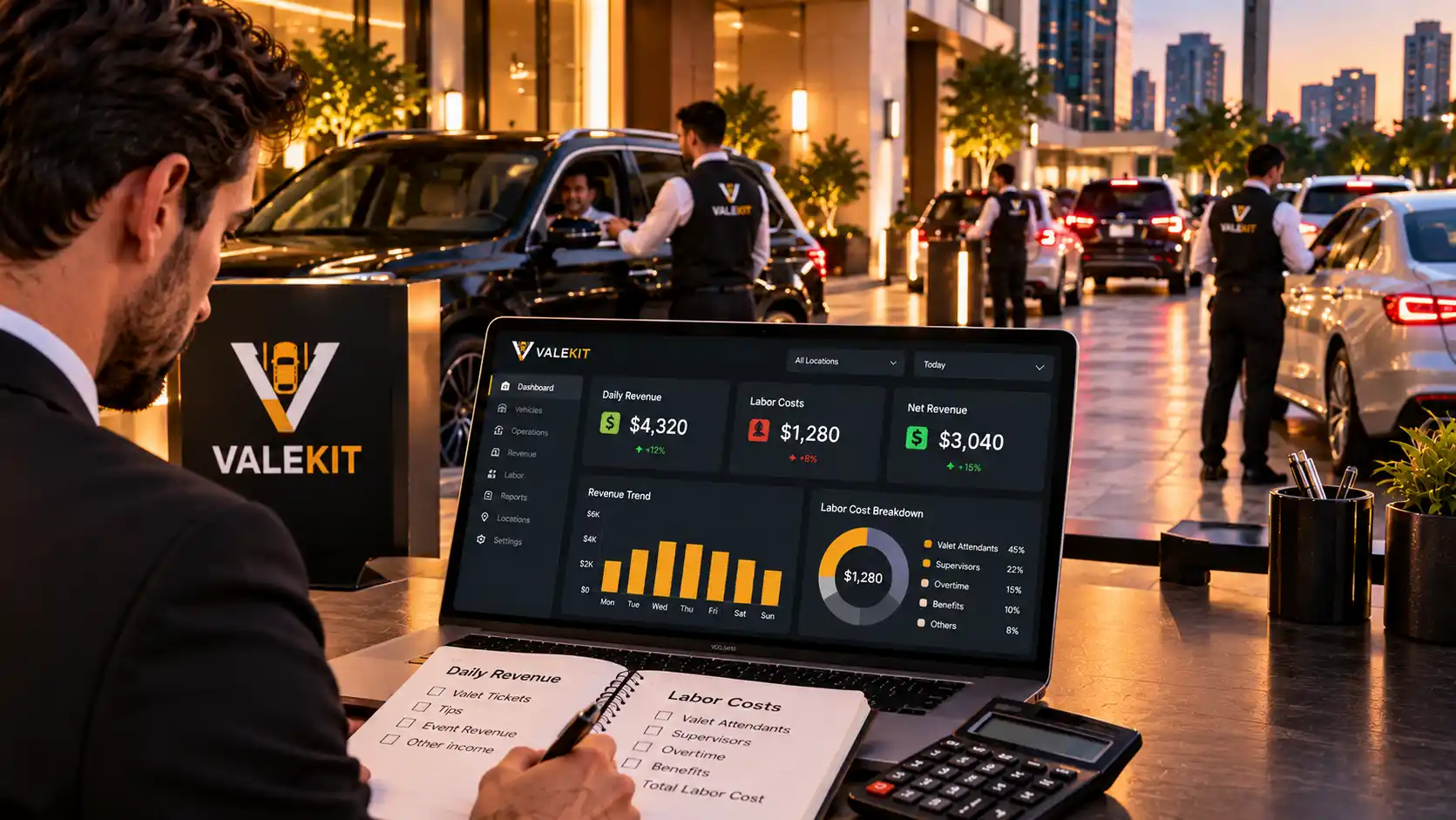
Valet and self-parking have different operating costs. Self-parking requires fewer staff members, while valet needs a team to receive, park, and retrieve vehicles.
- Lower staffing costs with self-parking: Guests park their own vehicles, so hotels need fewer parking attendants.
- Initial setup costs: Self-parking may require entry gates, payment machines, signs, and parking management systems.
- Higher labor costs with valet: Hotels need trained attendants, runners, supervisors, and insurance coverage.
- Different revenue potential: Valet parking often has higher nightly rates than self-parking. According to CBRE's industry report, hotel valet rates range from $40 to $75 per night, compared with $10 to $25 for self-parking.
However, higher valet rates do not always mean higher profits. Hotels must account for wages, insurance, vehicle handling, and daily operating expenses. Self-parking may generate less revenue per vehicle but can cost less to manage.
Compare the expected revenue with the total operating costs before choosing a model. You can also refer to our hotel valet pricing guide to understand the costs involved in running a valet operation.