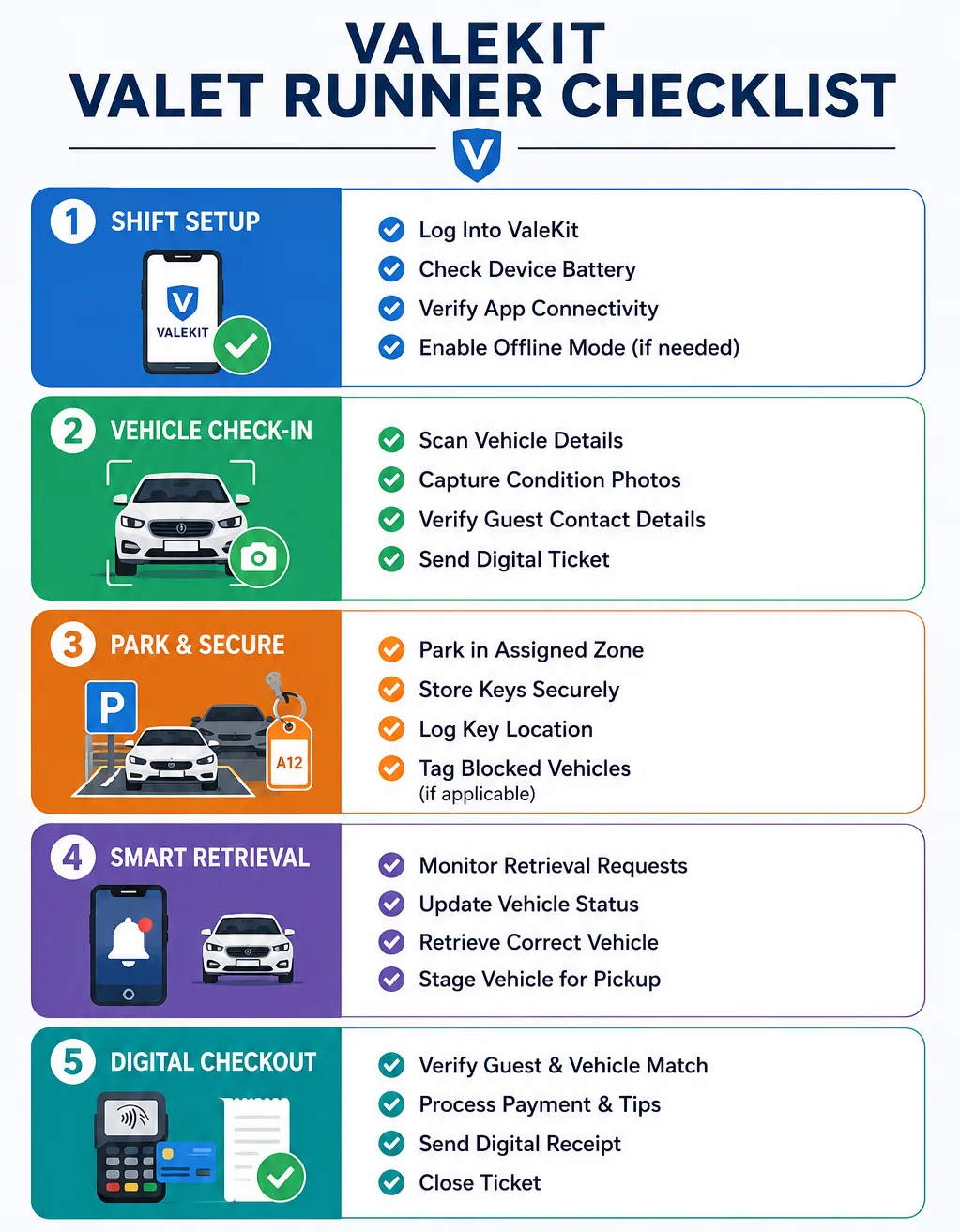
Most valet training happens on the job. A new runner shadows someone for a shift, picks up the workflow by watching, and is handed keys by the end of the week. This approach works until it produces a damage claim, a guest complaint, or a runner who developed bad habits from whoever trained them.
If you are running a valet operation at a hotel, restaurant, hospital, or any venue where guests hand over vehicles they care about, runner training is not an HR checkbox. It is risk management.
This guide covers what a proper valet attendant training program covers, how to structure it, and what separates runners who perform consistently from those who create operational problems.
At the bottom of this post, you will find a link to a downloadable valet runner training checklist you can use directly with your team.
Why Most Valet Training Fails
The most common failure in training valet staff is treating it as a single event rather than a process.
A new runner sits through a 30-minute orientation, gets shown the keyboard, follows a senior runner for one shift, and is then considered trained. Two weeks later, they are handling solo shifts on a busy Friday night with no clear standard for how to check in a vehicle, document existing damage, or communicate with a guest who has been waiting 15 minutes.
The problem is not that the runner is bad at the job. The problem is that they were never given a clear standard to operate against.
Good valet runner training is specific, repeatable, and checked, not assumed. It covers procedure, guest interaction, vehicle handling, and accountability, with the same detail for every runner regardless of how experienced they claim to be.
What Valet Runner Training Should Cover
1. Check-In Procedure
This is where the operation either creates a defensible record or fails to. Every runner needs to follow the same check-in process every time, regardless of how busy the stand is.
What to cover in training:
- How to greet the guest at the vehicle
- What information to collect: make, model, color, plate number
- How to inspect and document pre-existing damage before moving the vehicle
- How many photos to take and from which angles
- How to record the zone or parking location
- How to give the guest their claim reference, whether that is an SMS link or a physical ticket
The check-in is also the first guest interaction. Train runners to be calm, efficient, and clear. A rushed or dismissive check-in sets a bad tone before the car has moved.
2. Vehicle Handling
Valet runners drive vehicles they have never sat in before, repeatedly, under time pressure. This is where most damage occurs.
What to cover:
- How to adjust mirrors and seat position before moving any vehicle
- Maximum speed in the parking area, no exceptions
- How to handle unfamiliar vehicles: automatics with unusual gear configurations, push-button ignitions, rear-view camera systems
- How to handle high-value or unusual vehicles: convertibles, low-clearance sports cars, large SUVs with a tight turning radius
- Parking approach: always pull forward where possible, back in only when the space requires it
- What to do if a runner is not confident handling a specific vehicle
That last point matters. Runners who feel pressure to handle a vehicle they are not comfortable with will not speak up unless you have explicitly told them it is acceptable to do so. Create that expectation in training.
3. Key Control and Zone Management
Lost keys and misparked vehicles are the two most common causes of long retrieval times. Both are training failures.
What to cover:
- How keys are tagged and stored at the stand
- The process for recording the parking zone or bay for every vehicle
- What to do when a runner cannot find a vehicle (escalation procedure, not guessing)
- Key handover protocol at shift change
Runners should not be improvising key storage or zone logging based on what seems reasonable. There should be one process and every runner should follow it.
4. Guest Communication
A runner's interaction with a guest at drop-off and retrieval is the most visible part of the valet experience. Technical competence without basic guest communication skills produces a service that feels indifferent even when it runs smoothly.
What to cover:
- Greeting at vehicle arrival: what to say, how to say it, how to take keys efficiently without making the guest feel rushed
- Setting retrieval expectations: if wait time will be over five minutes, say so
- Handling a guest who is unhappy at retrieval, whether due to wait time or another issue
- How to respond when a guest reports potential damage: stay calm, do not admit liability, pull the check-in record immediately
Role-play these scenarios in training. Runners who have rehearsed how to handle a frustrated guest perform significantly better in the moment than those encountering it for the first time on a busy shift.
5. Retrieval Process
Retrieval is where wait time is earned or lost. Runners who handle retrievals efficiently keep guests moving and reduce complaint volume.
What to cover:
- How a retrieval request comes in, whether via SMS link, radio, or stand manager
- How to locate the vehicle using the zone record
- Expected retrieval time standards for your operation
- What to do when a vehicle cannot be located immediately
- Final vehicle check before returning it: make sure nothing was left in the vehicle during parking, doors are closed, mirrors are reset
6. Damage Reporting
Damage will happen. The question is whether it gets handled correctly when it does.
What to cover:
- What counts as reportable damage: any new contact mark, no matter how minor
- How to report immediately: runner tells the stand manager before the guest retrieves the vehicle, not after
- What not to do: do not attempt to hide damage, do not offer the guest a personal apology that implies fault, do not move the vehicle further before documentation is complete
- How the check-in photos are used in a dispute
Runners who understand the damage reporting process do not panic when something happens. Runners who have never been trained on it make the situation significantly worse by reacting badly in the first 60 seconds.